
Some posts on this site contain affiliate links. If you book or buy something through these links, I earn a small commission (at no extra cost to you). Take a look at my privacy policy for more information.
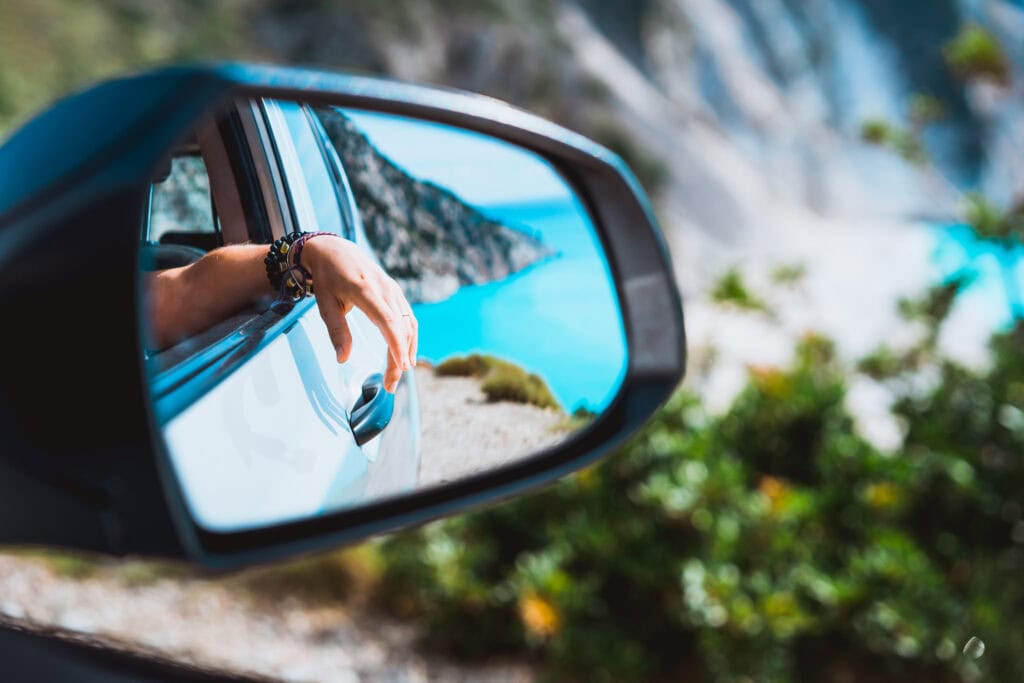
The real Greece doesn’t come with a tour bus window
Here’s the thing nobody tells you before you book a group tour of the Greek islands: the best bits aren’t on the itinerary. They’re down a dirt track, past a hand-painted sign, at a taverna where the menu is whatever the owner felt like making that day. You don’t find those places on a coach. You find them when you’ve got your own set of keys and absolutely nowhere to be by 4pm.
Renting a car in Greece is, more or less, one of the better decisions a solo female traveller can make – not just for the logistics of it, but for what it actually does to your trip. The whitewashed villages down unmarked lanes. The beach you stumbled onto after a wrong turn that somehow ended up being exactly right. None of that is available on a timetable.
Greece has a reputation for chaotic driving. Fine – it’s not entirely undeserved. But the freedom to stop wherever you want, linger as long as you like, and take the road that looks interesting rather than the road that’s on schedule? That changes everything. Once you’re off the tourist trail, traffic thins out fast. The mainland roads are generally solid. And you adapt to the driving culture quicker than you’d think.
The question, really, isn’t whether to hire a car. It’s how to do it without headaches.
What solo travellers should know before booking car hire in Greece
Sort the logistics early – it genuinely pays off here more than in most places. Anyone researching already knows that car hire Greece comparison platforms let you filter by transmission type, insurer, and pick-up location. That last one matters more than you’d expect, especially on islands with limited drop-off points.
A few things worth knowing before you hit “book”:
- Transmission: The default in Greece is manual. If you want an automatic – and many of us do, especially on mountain switchbacks – book it well in advance. They go early and cost a bit more. Don’t leave this one to chance.
- Age surcharges: Many providers work within a bracket of 25 to 70. Outside that range, expect an extra fee or mandatory excess insurance.
- Documentation: Non-EU citizens need an international driver’s licence. Easy to sort ahead of time; an absolute pain if you forget.
- Pricing: Roughly €25–€40 per day, rising steeply in July and August. A smaller car not only costs less – it’s also significantly easier to squeeze down village streets.
- Photo everything: Before you drive away, photograph any existing scuffs – body, windows, tyres, the lot. Do it every time. No exceptions.
Travel journalist Matthew Karsten, who road-tripped extensively through Greece, puts it plainly: “The freedom of picking your own routes, visiting archaeological sites at your own pace, and stopping whenever you want makes the whole experience worth it.” Hard to argue with that.
Where a car actually changes everything
Not every corner of Greece needs one. Athens is genuinely better on foot or metro – traffic-choked, parking a nightmare, and the centre is walkable enough that a car is more stress than it’s worth. But leave the capital, and suddenly everything shifts.
The Peloponnese might be the best argument for renting a car in Greece, full stop. It’s mainland Greece’s southernmost peninsula – loaded with some of the most well-preserved ancient ruins in the country, plus Byzantine ghost towns, dramatic coastline, and villages that tourism largely forgot. Getting between sites by bus is possible, technically. By car, the ancient citadel of Mycenae, the haunting ruins of Mystras, and the wild fingers of the Mani peninsula become a road trip rather than a logistics puzzle.
Crete is the other obvious answer. Secluded beaches, snow-capped mountains, ancient Minoan palaces, Venetian port towns – the island has extraordinary range, and with a rental car you actually get to see it. Stop at the tiny local taverna that catches your eye. Pull over for a view. Spend three hours somewhere you’d never heard of. That’s the version of Crete most visitors miss entirely.
Lesser-known mainland regions – Zagori in Epirus, the Pelion peninsula, the stone villages of Arcadia – are, frankly, difficult to reach without your own wheels. These tend to be exactly the kind of places solo travellers love most: few crowds, genuine character, and locals who are genuinely happy to see you.
Islands: yes, but with caveats
You can take a rental car onto the Greek islands via ferry – worth knowing, and worth planning around. That said, some islands actively limit car numbers on the road (Santorini’s traffic jams are, well, legendary), so driving short distances there isn’t always the win it sounds like. Milos, Naxos, and the quieter Dodecanese islands are a different story entirely – far more car-friendly, and they reward the effort.
Driving in Greece: what to actually expect
Brace for a driving culture that is… expressive. Greek drivers communicate through horn, gesture, and what appears to be a deeply personal interpretation of lane markings. It sounds more alarming than it is. Most visitors find they adapt reasonably quickly – the main highways have been modernised in recent years and are in decent condition.
What tends to catch people off guard:
- Rural roads: Narrow, sometimes poorly maintained, occasionally featuring unsecured mountain curves and – genuinely – herds of goats. Drive anticipatorily. Slowly.
- Village streets: Two-way, even when they really don’t look it. Someone will have to pull into a passing place. Cooperation is everything.
- Tolls: Typically €1.50–€3.50. Speed limits run 50 kph in towns, 90 kph on rural roads, 130 kph on motorways.
- Phones: Illegal while driving. Fines from €80 for a first offence – not worth it.
Navigation apps hold up well across most of Greece. Download offline maps before heading anywhere mountainous. Signal has a habit of disappearing precisely when you most need it.
A few practical notes for solo female drivers
Greece sits comfortably in the “safe for solo women” category – genuinely so, not just on paper. Standard precautions apply, as they do anywhere. When it comes to driving:
- Park in well-lit spots at night; don’t leave anything visible in the car
- Share a rough itinerary with someone back home – a habit worth keeping
- Save 112 (general emergency) in your phone before you leave the airport
- Carry cash for tolls; not all stations take cards
Timing matters. Spring – April to mid-June – is, by most accounts, the sweet spot: mild temperatures, landscapes in bloom, and meaningfully fewer crowds. Early September runs a close second. Peak summer works, but factor in traffic and book accommodation well ahead.
Final thoughts
There’s a version of Greece that most visitors simply never reach – not because it’s hidden, exactly, but because finding it requires a little independence. A rental car is the most direct route to it. The Peloponnese at sunrise when you’re the only car on the road. A beach on Naxos with no name on the map. A village in the Zagori gorges where the taverna owner brings out dishes you didn’t order, because he’s decided you’ll like them. (You will.)
Solo travel in Greece by car suits women travelling alone particularly well – the country is welcoming, the roads are manageable with a bit of patience, and the payoff for going off-script is genuinely significant. Book the automatic early. Photograph the car before you drive it anywhere. And leave at least one day with no fixed plan. That’s usually when the best things happen.