
Some posts on this site contain affiliate links. If you book or buy something through these links, I earn a small commission (at no extra cost to you). Take a look at my privacy policy for more information.

Okay so. Osaka, 2023, nearly midnight. I’m standing outside the airport with a dead phone, a hostel address I can’t pronounce, and a taxi driver who keeps smiling apologetically at me. My battery had died somewhere over Siberia. The info desk had shut. The free airport Wi-Fi wanted a Japanese phone number to verify. And I had been, in my infinite wisdom, planning to “just grab a SIM at the airport”, which, it turned out, was not a thing at that terminal past 10pm.
Forty minutes later, I was in the right taxi. Probably. I showed the driver a screenshot I’d taken the week before of the hostel photo; he made a face that I chose to read as recognition, and off we went. It was fine in the end. But that was the trip where I properly promised myself: never again.
If you travel solo, especially as a solo female traveller, your phone isn’t a convenience on the road. It’s a map. A translator. A rideshare app. The thing that tells your mum you landed. Being offline the second you step off the plane isn’t an inconvenience – it’s a safety issue. Hence, this guide. Hence why I now set up an eSIM before I even leave the house!
Why being connected matters more when you travel solo
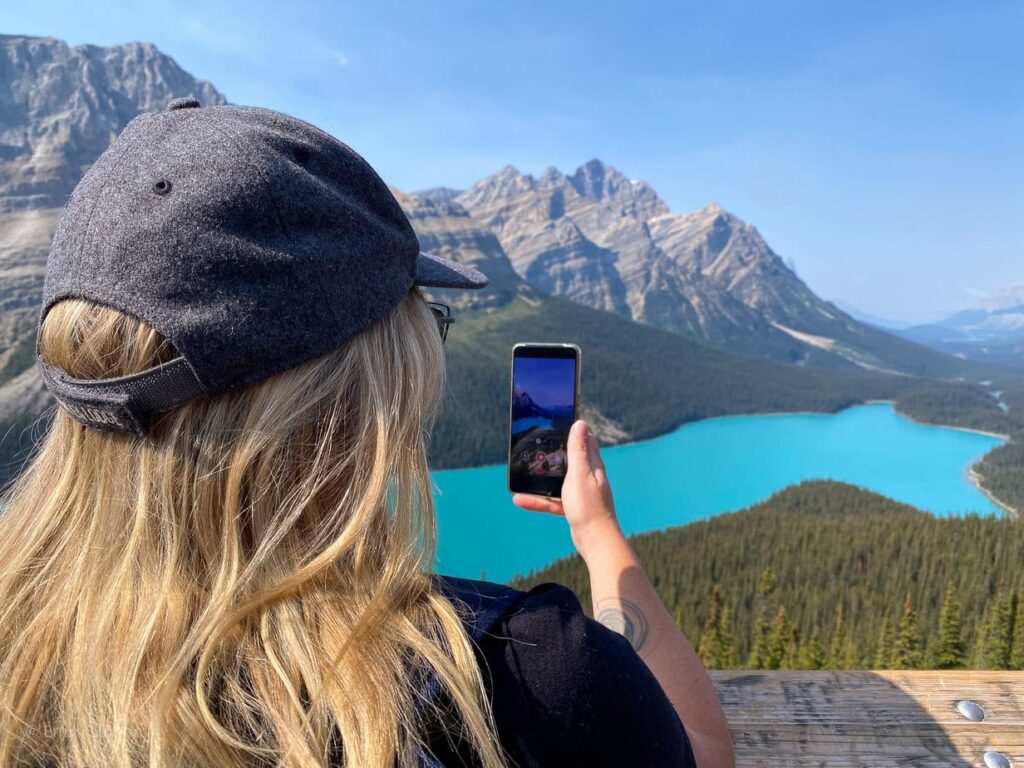
Here’s the honest truth. When you travel with friends, being offline is annoying. When you travel alone, being offline in the wrong place can put you in properly dodgy situations. I’m not being dramatic. I’ve been in them.
What I actually use mobile data for on a solo trip:
Google Maps, obviously, so I don’t accidentally wander into the wrong neighbourhood at 11pm looking for dinner. Uber or Bolt or Grab, depending on the country, because getting into an unmarked local taxi at night when you don’t speak the language is a roll of the dice I’d rather not play. Google Translate — sometimes for menus, sometimes for far less charming situations like “where is the pharmacy, I’m very ill”. WhatsApp live location, shared with one friend back home, any time I’m in a car after dark. Booking.com or Hostelworld for last-minute bed changes when the place I turn up at doesn’t feel right. And just the basics: emergency numbers, maps of the nearest hospital, and the ability to call someone.
None of that runs on hotel Wi-Fi that drops every twelve minutes. And it definitely doesn’t run on roaming charges from your home network that cost a fiver a day and come with a data cap of ten megabytes or something mental like that. You need proper data. For solo female travellers, I’d call it non-negotiable.
So what is an eSIM, really?

It’s a digital SIM card. That’s the whole explanation. Lives inside your phone, no physical bit to swap in or out, no tiny tray to pop open with a paperclip you can never find. You buy a data plan online. The company emails you a QR code. You scan it. Done.
The bit that matters: your original phone number stays active. You don’t lose calls or texts to your UK number – the eSIM just handles your data in the background. Most modern phones let you run dual SIM, so your home SIM sits there happily while the travel eSIM does the heavy lifting.
Massive deal if, like me, you used to faff with a local SIM in every country. Thirty minutes queueing at the airport SIM desk. Showing your passport. Swapping your physical SIM card out, stashing it somewhere you’ll definitely remember (ha!). Being unreachable on your normal number for the whole trip. I did that for years. I won’t do it again.
Is your phone eSIM compatible?
Check first. Seriously, before anything else. Most phones from the last four-ish years are eSIM compatible, but not all eSIMs work on every phone model, and nothing ruins your first day abroad like realising your old Pixel doesn’t support eSIM.
Rule of thumb: iPhone XS and newer, Samsung Galaxy S20 and newer (plus the Z Flip/Fold range), Google Pixel 3 and newer. If you’re on the US version of an iPhone 14 or later, heads up: those are eSIM-only. No physical SIM tray at all.
Quick way to check: dial *#06# on your phone. If you see an EID number in the info that pops up, you’re good to go. Thirty-second job. Do this before you buy an eSIM plan, not after, because refunds on used eSIMs are a grey area with most providers.
What I actually look for in an eSIM
I’ve tried a handful. Some brilliant. Some a faff. One I’d rather not name that I lost a tenner on in Cambodia. My checklist now looks like this (not in order, just the things I weigh up):
Coverage that matches how I actually travel. That means single-country eSIMs when I’m focused on one destination (a fortnight in Japan, a week in Thailand, a long weekend in Istanbul), and proper regional plans for multi-country travel. For example, a Europe regional plan if I’m hopping between multiple countries in one go, a Southeast Asia plan if I’m doing the classic backpacker loop.
Instant access matters too. I want the QR code in my inbox within seconds of paying. Not an hour. Not “allow up to 24 hours for manual approval”. Seconds. And I want to be able to install the eSIM at home, days before I fly, so I’m online the moment I land.
Transparent, affordable prices. Fixed plans. No hidden fees tacked on at checkout. No auto-renewing subscriptions that pop up on my credit card statement three months later when I’ve forgotten all about them. What I see is what I pay.
Reliable coverage on local networks. This is the one nobody talks about. The best eSIM in the world is useless if it partners with a dud local carrier. When I’m researching an eSIM, I Google the exact question: “Does X eSIM work well in Y country?” If there are three threads of people complaining about slow speeds in secondary cities, I move on.
Real customer support. Not a chatbot. A person. When something goes wrong at 11pm in Phuket – and at some point, something will – I want to talk to someone who can actually help. This one rules out a surprising number of eSIM companies.
Flexible plans across data usage levels. Sometimes I need 1GB for a weekend in Lisbon. Sometimes, unlimited data for a month in South Korea. Good eSIM providers cover both ends without forcing me into a plan I don’t need.

The eSIM providers I’ve actually paid money for
Airalo is the big one, the household name. Biggest catalogue, works in most destinations, clean app. Their plans come with data caps that can feel tight if you’re on Google Maps and video calls every day. Fine for a short trip, less great for a long one.
Holafly markets itself hard on unlimited data. And honestly, it’s reliable. The pricing sits at the higher end though, so unless you’re genuinely a heavy data user, I’ve found cheaper options that gave me enough data without the premium.
Saily – the one from the Nord team – is slick. Easy to use, solid pricing, decent coverage. I had two instances of frustratingly slow speeds in Eastern Europe that Airalo didn’t have in the same week. Might’ve been bad luck, might’ve been the carrier they use there. I’d still try it again.
Roambit eSIM is where I’ve landed for my next few trips. Full transparency, they sponsor this post, but they’re also the provider currently installed on my phone for my next trip (Albania and Montenegro, road trip, end of June). More on why below.
There are dozens of smaller eSIM companies out there too. Not all eSIMs are created equal. Some of the really cheap ones have patchy deals with weak local carriers, and I’d rather pay £3 more for something that works.
Why Roambit has quietly become my go-to
A few things stood out when I tried Roambit eSIM:
The coverage. 200+ destinations. Single-country eSIMs for Japan, USA, Turkey, UAE, Thailand, Vietnam, Egypt – basically any country you’re likely to end up in.
The Europe regional plan covers 36 countries. That’s a proper list, not a “three countries and we’ll call it Europe” situation. Austria, Belgium, Bulgaria, Canary Islands, Croatia, Cyprus, Czech Republic, Denmark, Estonia, Finland, France, Germany, Greece, Hungary, Iceland, Ireland, Italy, Latvia, Liechtenstein, Lithuania, Luxembourg, Malta, Netherlands, Northern Cyprus, Norway, Poland, Portugal, Romania, Slovakia, Slovenia, Spain, Sweden, Switzerland, Turkey, the UK, Vatican City. One eSIM, thirty-six countries. If you’re doing a long train trip or Interrail thing, this is the move.
And then – this is what actually sold me – they have a dedicated Balkans regional plan. Albania, Bulgaria, Croatia, Greece, Montenegro, North Macedonia, Serbia. Almost no other eSIM provider runs this as a standalone plan. Most of them bolt Albania or Montenegro onto a Europe-wide plan with whatever local carrier happens to exist there, and the speeds show it. Roambit runs the Balkans as its own regional package, which means better local networks for anyone road-tripping the region. Given that’s my next trip, this mattered to me.
Activation is genuinely under two minutes. Buy, QR code arrives, scan, done. No SIM manager faff. Your original phone number stays active: calls and texts to my UK number still come through on my home SIM while the eSIM handles the data.
Flat pricing. What you see is what you pay. No auto-renewals.
And (small thing, but I test this with every new provider), customer support responded to my 10pm Sunday email within two hours. From an actual person. Not “your ticket number is #44921, we’ll respond within 48-72 hours”. A human. Called Emma, I think.
PROMO CODE: Use EMILY10 at checkout for 10% off your first plan.
Regional plan or single country?
Asked this a lot. Easy answer:
One country, one single-country eSIM. Cheaper per GB, zero hassle.
Multiple countries in the same region, one regional plan. Don’t install a new eSIM at every border – that’s six QR codes and six invoices for a trip that could use one.
Global plans exist. I don’t really use them. They’re priced for flexibility rather than value, and the flexibility is only useful if you’re doing three or four continents in under a month. For most solo trips, regional plans are the sweet spot.

Setting up your eSIM
It really does take about two minutes. Here’s what you actually do, written the way I’d tell a friend rather than a manual:
Get home, connect to your Wi-Fi, open the email with the QR code on a laptop or iPad (you need a second screen because the QR code can’t be on the same phone you’re installing it on; I learnt that the hard way in 2022).
On your phone, head to Settings > Mobile Data > Add eSIM. On iPhone, it might say Cellular Plan. Scan the QR code with your camera. Give the new line a label so you can find it later (“Roambit Balkans” or whatever).
Keep your home SIM as the default for calls and texts. Switch the eSIM to the default for data. Turn data roaming ON for the eSIM line specifically. This is the one people forget, so double-check it.
That’s it. You can do all of that at home, days before you fly. The eSIM doesn’t actually start using data until you arrive and it connects to a local network, so you won’t burn through your plan testing it.
Safety tips that depend on being online
A few things I do on every solo trip that wouldn’t work without reliable data:
Live location, shared with one person at home, always active in a taxi or walking back after dark. WhatsApp does this, so does Google Maps. Costs nothing. Gives you and whoever you love a bit of peace of mind.
Download the offline Google Map for the city before you arrive, as a backup. Data coverage drops in rural areas. Offline maps have saved me more than once when the local networks dipped.
Save the emergency numbers before you land. 112 across most of Europe. 911 in the US and Canada. 119 in Japan. 100 in Greece. Knowing them matters if your data temporarily drops.
Install a safety app. Google Personal Safety is free on most Androids. bSafe and Noonlight are also good. Hopefully, you never use them. But one tap is better than no tap.
Check in daily with someone at home. Sounds paranoid. Isn’t paranoid. Is just sensible.
And the thing most people skip: test everything before you leave the airport. Before you walk outside and get into a cab, confirm your eSIM is live, Maps loads, your rideshare works, and WhatsApp sends. If any of those fail, sort it while you’re still somewhere with staff and Wi-Fi.

How much data do solo travellers actually need?
Honest numbers from my own trips:
For a casual user (maps, messaging, a bit of scrolling), 1-3GB a week is plenty. For a standard user (maps, rideshare, social, some video calls home), I budget 5-10GB a week. For a heavy user (daily video calls, Netflix on long buses, uploading photos and reels), unlimited plans make more sense than trying to ration.
For my last two-week solo trip in Thailand, I used about 8GB total. For a fortnight in South Korea last autumn, 11GB. For the Balkans trip I’m planning, I’ve bought the 10GB plan, and I’m expecting that’s generous.
If you’re going somewhere for more than three weeks, just pay the extra for unlimited. You’ll spend the whole trip anxious about running out otherwise.
Mistakes I’ve made so you don’t have to
I bought an eSIM at the airport once, in the “oh god I forgot” panic. Free airport Wi-Fi was slow, the QR code installation kept failing, and I wasted 25 minutes of my first day in a country I’d flown thousands of miles to see. Install at home. Always.
I didn’t check eSIM compatibility once, for a friend’s older Pixel. Turned out not to be eSIM compatible. £15 of data plan in the bin. Would’ve taken 30 seconds to check with *#06#.
I forgot to toggle data roaming on the eSIM line once, panicked, emailed the provider, accusing them of not working, got a very polite reply pointing out that data roaming was off. Classic!
I went cheap once. The £4 plan for a week in Morocco. Couldn’t load Google Maps in Chefchaouen, which is exactly where you need it. Lesson: sometimes the £4 saving costs you two hours of your life.
I chose an eSIM with no real customer support once. Something broke, the chatbot couldn’t help, the email support took 36 hours to reply, and by then I’d given up and bought a local SIM at a kiosk anyway. Now I only use providers with actual human support teams.

Quick version if you skipped to the bottom
An eSIM is the simplest, safest, and most affordable way to stay connected while travelling solo in 2026. Skip the roaming charges. Skip the airport SIM queues. Skip swapping your physical SIM card every time you cross a border.
For my own trips right now, I’m using Roambit eSIM. 200+ destinations. Transparent pricing. Human support. A proper Balkans plan that most competitors don’t offer. Use EMILY10 at checkout for 10% off your first eSIM plan.
And wherever you’re flying to next – solo or otherwise – install the eSIM before you leave the house. Test it at home. Land already connected. That Osaka taxi queue was the last time I travelled without one. And I haven’t missed it for a second.