
Some posts on this site contain affiliate links. If you book or buy something through these links, I earn a small commission (at no extra cost to you). Take a look at my privacy policy for more information.
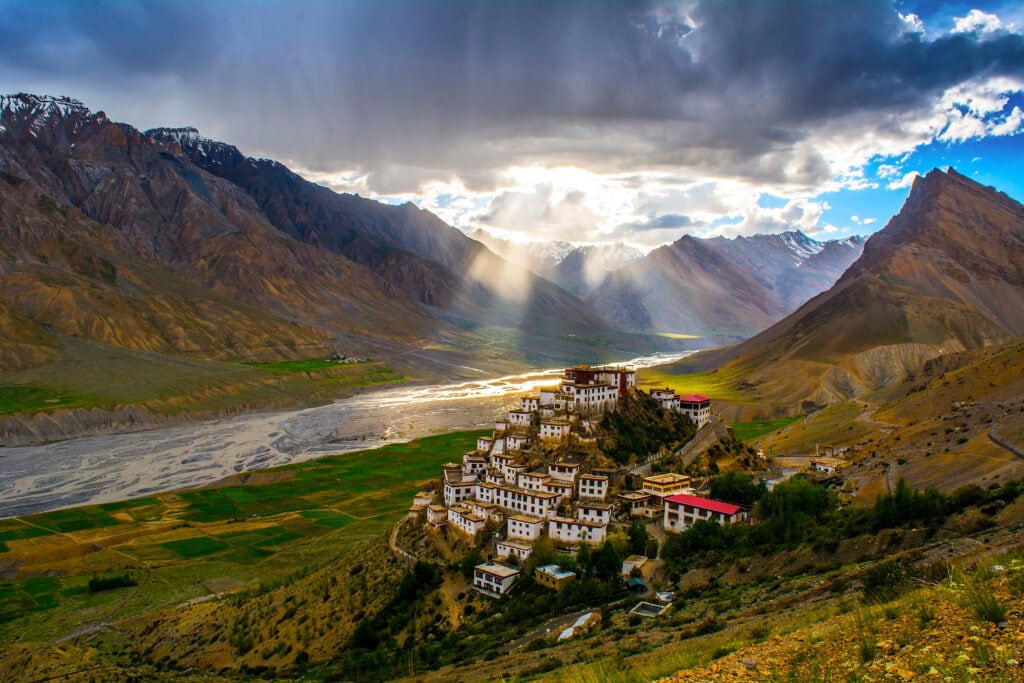
The air in Spiti doesn’t just feel thin; it feels ancient. As I crossed the threshold of the Kunzum Pass, the vibrant greens of the lower Himalayas withered away, replaced by a stark, lunar landscape of bruised purples and sun-scorched ochre. Here, in the “Middle Land” between earth and sky, the silence is so heavy you can almost hear the flutter of prayer flags miles across the valley. Most travelers come here for the jagged peaks and the Instagrammable monasteries clinging to the cliffs, but Spiti isn’t a place you simply look at. It’s a place that demands you slow your pulse, steady your breath, and listen to the stories etched into its prehistoric dust. To find the secret soul of this cold desert, I had to stop chasing the viewpoints and start following the scent of juniper smoke and the quiet hum of a thousand-year-old tradition.
The Threshold of Another World: Crossing Kunzum Pass
Entering Spiti Valley is less of a drive and more of a metamorphosis. One moment you are surrounded by the weeping deodars and misty valleys of Himachal’s lower reaches, and the next, you are cresting the Kunzum Pass. At nearly 15,000 feet, the pass acts as a gateway to a different dimension.
From Lush Greenery to Lunar Landscapes
The transition is jarring in the most beautiful way. The moisture leaves the air, and the palette of the world shifts. You leave behind the “Alpine” India and enter a “Martian” one. It’s a sensory reset. Why do we travel if not to be shocked by how diverse our planet can be? This high-altitude desert doesn’t offer shade or easy comfort; it offers raw, unfiltered perspective.
The High-Altitude Oasis of Resilience
Spiti is often called a “Cold Desert,” a term that feels like an oxymoron until you’ve felt the sun burn your skin while your breath turns to frost in the shade. The beauty here isn’t soft; it’s hard-won. It is an oasis of resilience where every blade of grass and every mud-brick home is a testament to surviving against the odds.
Stripping Away the Modern Noise
In our hyper-connected lives, we are constantly bombarded by “noise”—both literal and digital. Spiti strips that away. There is no 5G at the top of a mountain ridge. When the pings of notifications vanish, you’re left with the sound of the wind. Have you ever noticed how loud your own thoughts are when the world goes quiet? Spiti forces a connection with yourself and a culture that has thrived in isolation for centuries.
The “Little Tibet” Essence: Deep Cultural Immersion
While Spiti is politically in India, its soul is deeply entwined with Tibet. This “Little Tibet” isn’t a museum; it’s a living, breathing culture. To understand Spiti, you have to look past the dramatic architecture of the monasteries and look at the hands that turn the prayer wheels.
Tabo Monastery: The Silent Heart of the Valley
Often referred to as the “Ajanta of the Himalayas,” Tabo Monastery is a marvel of mud and spirit. Unlike the towering white fortresses of Key or Dhankar, Tabo is humble, hugging the earth.
The Scent of Juniper and the Weight of 1,000 Years
Walking into the main temple is like stepping back ten centuries. The dim light reveals frescoes that have survived a millennium of winters. But it’s the silence that hits you first. It’s a heavy, sacred silence, punctuated only by the faint scent of burning juniper incense. It’s a place where time doesn’t just slow down; it feels like it has completely stopped.
Lessons in Contentment from Mane Village
In the small village of Mane, I sat with a local family who lived primarily on what they could grow in the short summer months. There is a philosophy here that is hard to find in the city—a deep, unshakable contentment. A local monk once told me, “We don’t have much, but we have enough.” It’s a simple sentiment, but in the thin air of Spiti, it sounds like the ultimate wisdom.
The Art of Slowing Down: An Overland Meditative Transit
The “road” to Spiti is legendary, often cited as one of the most dangerous in the world. But if you’re rushing to get to the destination, you’re missing the point.
The Journey as the Destination
The long, winding route from Shimla through Kinnaur is a “meditative transit.” You watch the Satluj river carve through canyons, and you feel the scale of the mountains grow until you feel like a mere speck of dust. This isn’t a commute; it’s a pilgrimage. The bumps in the road aren’t obstacles; they are reminders to stay present.
Kaza Market: Finding Stillness in the Hub
Kaza is the “capital” of Spiti, but don’t expect a bustling metropolis. It’s a hub of slow life. I found myself sitting in a small café for three hours, just watching the locals trade wool and travelers swap stories. There’s a peculiar magic in not having a “plan.” When was the last time you just sat and watched the world go by without checking your watch?
Beyond the Viewpoints: The Magic of Secret Spots
Everyone goes to Key Monastery for the iconic photo, but the “secret soul” of Spiti is found in the places that require a bit more effort to reach.
Langza: Walking on a Prehistoric Ocean Floor
Langza is famous for its giant Buddha statue watching over the valley, but the real treasure is beneath your feet. Millions of years ago, this was the Tethys Ocean. Today, you can walk through the dry, high-altitude fields and find marine fossils—Ammonites—embedded in the earth. It is a humbling reminder of the earth’s grand timeline. You are standing on what was once the bottom of the sea, 14,000 feet in the air.
Hikkim: Sending Love from the Edge of the World
Hikkim houses the world’s highest post office. There is something profoundly romantic about writing a physical postcard in a digital age, knowing it will travel from this remote mountain outpost to a mailbox thousands of miles away. It’s a slow form of connection that fits the rhythm of the valley perfectly.
While Hikkim lets you send a physical postcard from the clouds, staying digitally connected in these remote corners requires a bit more foresight. Between hopping on sketchy café Wi-Fi in Kaza and navigating restricted networks, I always make sure to download ExpressVPN before I head into the mountains. It’s my digital safety net, keeping my banking and personal data secure even when the connection feels as thin as the air at 14,000 feet.
The Human Connection: The Soul of the Spitian Homestay
If you stay in a hotel, you’ve seen Spiti. If you stay in a homestay, you’ve felt Spiti.
Thukpa, Wood-Stoves, and Heartfelt Hospitality
There is no warmth quite like a Spitian kitchen. Centered around a traditional wood-fired stove (the bukhari), the kitchen is the heart of the home. Sharing a steaming bowl of Thukpa (noodle soup) with your hosts while the wind howls outside is the peak Spiti experience. The hospitality isn’t “service”—it’s a genuine sharing of life.
Conclusion: What the Silence Teaches Us
Spiti is an incredible destination for solo female travellers in India, offering a sense of safety and community that is hard to match. As I left the valley, the modern noise began to creep back in—the hum of engines, the glow of streetlights, the frantic pace of people with places to be. But I carried the silence of Spiti with me. This valley teaches you that resilience isn’t about being loud; it’s about standing firm like the mountains. It teaches you that “deep travel” isn’t about how many miles you cover, but how much of the place you let cover you. Spiti isn’t just a destination; it’s a reminder that beneath the postcard-perfect views, there is a soul that is ancient, resilient, and profoundly quiet.
Frequently Asked Questions (FAQs)
1. When is the best time to visit Spiti Valley for “Deep Travel”? For the best experience, visit between June and September. The roads are open, and the weather, while cool, allows you to explore the high villages like Langza and Hikkim without being snowed in.
2. Is Spiti Valley safe for solo female travelers? Absolutely. The Spitian people are incredibly hospitable and respectful. The main challenge isn’t safety from people, but safety from the environment—acclimatization is key!
3. Do I need a permit to visit Spiti? Indian tourists do not need a permit. However, foreign nationals require an Inner Line Permit (ILP) to travel through the Kinnaur-Spiti route due to its proximity to the border.
4. How do I prevent Altitude Sickness (AMS) in Spiti? The golden rule is “Ascend slowly.” Spend a night or two in Shimla or Kalpa to acclimatize. Drink plenty of water, avoid alcohol, and listen to your body.
5. What should I pack for a Spiti trip? Think layers! Even in summer, temperatures can drop at night. Pack thermal wear, a good windcheater, sturdy trekking shoes, and a high-SPF sunscreen—the mountain sun is no joke.